STERNOMASTOID RUPTURE AN INDEX OF ANTEMORTEM HANGING - AN AUTOPSY STUDY OF HUNDRED CASES
Sivasuthan S*, Girish S**, Babu PK***, Padmakumar****, John L****, Unmesh AK****, Raveendran R****, Balram NA****
* Professor H.O.D of Forensic Medicine & Police surgeon, Medical College, Alappuzha, Kerala.
** Professor H.O.D & Police Surgeon, Department of Forensic medicine, Medical College, Thiruvananthapuram.
*** Assistant Professor of Biostatistics, SAT Hospital, Thiruvananthapuram
**** Post Graduate trainees in Forensic Medicine, Medical College, Thiruvananthapuram.
Introduction
Hanging remains to be one of the common methods of committing suicide. Homicidal and accidental hanging is rare1, 2 . Hence all cases of hanging are considered suicidal until the contrary is proved3. Because of the above, postmortem suspension of the body may be resorted to cloak a crime. Therefore meticulous dissection and sharp distinction between ante mortem hanging and postmortem suspension is warranted.
There is no specific gold standard to distinguish between ante mortem hanging and postmortem suspension. How ever presence of-
• Vertical salivary dribble mark from the dependant angle of mouth4, 5,
• The phenomenon of Le Facies sympathique6,
• Hyperemia and echymosis of margins of ligature mark5 and
• Horizontal tear of the intima of carotid artery at level of ligature with infiltration around7, 8
- are considered as ante mortem features of hanging.
But obvious salivary dribble mark could be detected only in 56% of cases9. A meticulous examination of the body right at the scene of occurrence itself, that too before removing the clothes and apparels only can give the real prevalence of it. Le Facies sympathique, a phenomenon where one eye will be open with its pupil dilated than the other. This phenomenon is very rare in hanging and it was observed in different studies to be as low as 1%9 and 2%10. Horizontal tear of the intima of the carotid artery is also very rare phenomenon observed in 1% only9.
In the above circumstances detection of an ante mortem phenomenon that is quite frequent than the above, and that which cannot be artificially produced or tampered is quite essential.
Research question
Can the rupture of lower attachment(s) of sternomastoid muscle(s) with infiltration of blood be an index of ante mortem hanging?
Objective
The objective – To determine the prevalence of rupture of lower attachment(s) of sternomastoid muscle(s) in ante mortem hanging.
Hypothesis
When a ligature around the neck suspends a body, the ligature through the muscles connecting the trunk to the head carries the weight of the body. Prominent among those muscles are the Trapezius and the Sternomastoids. Trapezius being a very broad muscle having extensive attachments to the trunk is in accessible during the routine postmortem dissection. But Sternomastoid(s) are strong and bulky muscles, the lower attachments of which can easily be dissected and examined. When weight of the trunk is born by these muscles during suspension, there is every chance for rupture of the lower attachment of the muscles. In the case of hanging, death occurs in five to ten minutes except in judicial hanging where it is almost instantaneous, but the heart continues to beat for 15 to 20 minutes. Hence if the rupture of the muscles occurs, there will be definite infiltration of blood at the site. Such an infiltration will not occur if a dead body is suspended (post mortem hanging).
Materials and methods
The study was conducted on one hundred bodies brought for medico legal autopsy to the mortuary of Medical College, Thiruvananthapuram with history of death due to hanging.
A modified form of dissection with special care on avoiding artifacts on neck structures was adopted to note the partial rupture with infiltration of blood at lower attachment(s) of sternomastoid muscle(s). The observations as to whether rupture of lower attachment(s) of sternomastoid present or not were noted against the serial number age and sex of the deceased. To minimize bias, similar observations were made simultaneously by two other observers and recorded.
Inclusion criteria
Only cases with history of hanging where there is no external injury on the neck other than the ligature mark of hanging was included.
Exclusion criteria
• All cases with injuries on the neck other than that of the ligature
• Cases with postmortem interval of more than 18 hours to avoid artifacts due to decomposition.
Study duration
22 months from January 2003 to October 2004.
Study center
Department of Forensic medicine, Medical College, Thiruvananthapuram, Kerala.
Observations
Of the one hundred cases studied. Three independent observers noted age, sex and presence or absence of sternomastiod(s) rupture simultaneously. The findings were tabulated and analyzed.
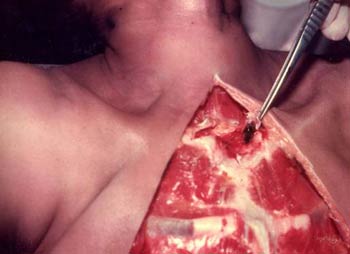
Figure showing the ‘partial rupture’ of sternal head of left sternomastoid muscle.
Fifty-nine were males and 41 females, ranging from 12 to 78 year age group. 62 percent of cases showed rupture of the lower attachment of sternomastoid muscles. The observations of all the three observers were found tallying.
Table: 1. Sex vice prevalence of Sternomastoid rupture
|
MALE |
FEMALE |
|
|
PRESENT |
37 (63%) |
25 (61%) |
|
ABSENT |
22 (37%) |
16 (39%) |
|
TOTAL |
59 (100%) |
41 (100%) |
X2=. 03, p> 0.05
It was found that there is no significant difference in the prevalence between male and female subjects.
Table:2. Age vice prevalence of sternomastoid rupture
|
Age group |
Present |
Absent |
Total |
|
12-21 |
9 (75%) |
3 (25%) |
12 |
|
22-31 |
16 (70%) |
7 (30%) |
23 |
|
32-41 |
7 (37%) |
12 (63%) |
19 |
|
42-51 |
13 (72%) |
5 (28%) |
18 |
|
52-61 |
10 (59%) |
7 (41%) |
17 |
|
62-71 |
6 (60%) |
4 (40%) |
10 |
|
72-81 |
1 (100%) |
0 |
1 |
It was found that in the age group 32 to 41 the prevalence is significantly low to the tune of 37% as against 62% generally.
Discussion
Of the hundred cases studied, 62% of cases showed rupture at the lower attachment of sternomastoid muscle(s). This significant number of positive cases supports the hypothesis that there will be snap or rupture at lower end(s) of the muscle during hanging. All the cases included in the study were otherwise proved to be ante mortem by police enquiry. The absence of any disparity in the findings of the different observers shows that the observation is quite simple and easy task. The absence of any significant difference between the two sexes again increases its credibility.
Conclusion
Since there is a significant prevalence of sternomastoid ruptures in ante mortem hanging, its presence can be considered as a reliable sign of ante mortem hanging.
Suggestion
The reason for the relatively low prevalence of the finding among 32 to 41 year group has to be further studied.
Bibliography
1. Franklin CA (ed). Modi’s Textbook of medical jurisprudence and Toxicology.20th ed. N.M. Thripathi Pvt. Ltd. Bombay. 1977;pp142-9.
2. Reddy KSN. The Essentials of Forensic medicine and Toxicology.4th edn. Reghumohan Printers, Hyderabad 1979;pp222-7.
3. Guharaj. Forensic Medicine. Orient Longman.1982; pp169-76.
4. Polson CJ. Essentials of Forensic Medicine. 2nd edn. Pergmon Press London, 1965;pp288-315.
5. Mukherjee JB. Forensic medicine and Toxicology. Academic Publishers, Calcutta 1981; 457-77.
6. Martin E cited by Polson CJ. Essentials of Forensic Medicine.2nd Edn. Pergmon Press London.1965; pp288-315.
7. Polson CJ, Gee DJ. The Essential of Forensic medicine, 3rd ed. Pergmon Press, New York 1973; 382-385.
8. Spitz, Fischer. Medico legal investigation of death.2nd ed. Pergmon Press New York 1978; pp382-5.
9. Sivasuthan S. (1988) Medico legal aspects of deaths with history of hanging, Thesis submitted to University of Kerala.1988.
10. Madanmohan A. A study of death due to hanging. Thesis submitted to University of Calicut. 1982.