Back to Index
IIJFMT 3(3) 2005
drowning associated diatoms
Rajvinder Singh, Rajinder Singh, Mukesh Kumar ThakarDepartment of Forensic Science, Punjabi University, Patiala-147002
Introduction
Drowning is type of asphyxial death by submersion in a fluid, whether or not the fluid is aspirated into the lungs. This is considered as the cause of death if the death occurs within 24 hours of the insult and if survival is beyond 24 hours after the submersion and implies that recovery has occurred after the insult it is called near drowning.
Diatoms are among the well known water planktons. Every water body has its own diatom diversity. Diatoms are autotrophic in nature and different genera are found in both marine and fresh habitats. Diatoms belong to class Bacillariophyceae and further divided into two orders i.e. Centrals and Pennales on the basis of their symmetry. There are about 10,000 species and 174 genera of diatoms having different shapes and sizes ranging from 1 to 500μm. Diatoms are commonly found in water bodies like ponds, lakes, canals and rivers etc. but their concentration can be low or high in a particular water body, depending upon the season. With regard to another feature-the water depth limits to benthic distribution-there is no incontrovertible evidence for autotrophic growth of diatoms below about 100 m.
When drowning takes place, diatoms enter into the lung cavity of a person through the aspirated water and this water exerts a pressure on lung cavity and rupturing of the lung alveoli takes place. Through these entrances diatoms can enter into heart, liver, kidney, brain and bone marrow. As diameter and thickness of lung alveoli remains between very small therefore it is not impossible for all the diatoms to penetrate into the body organs through the lung cavity and diatoms which can penetrate through this capillary network are called “Drowning Associated Diatoms” (DAD).
Analysis of diatoms present in the lungs, liver, spleen, blood and bone marrow has for many years been undertaken as a confirmatory test in possible downing cases. However, the diatom test has been controversial since numerous cases of false negative and false positive results have been documented. Careful analysis of diatoms is a useful means of determining whether or not death occurred while the face was submerged in water. Before diagnosis of death by drowning an emphasis must be made on the morphological and morphometric studies of diatoms from the putative drowning medium because penetration of a diatom in lung capillaries depends upon its size and density Hurlimann et al. (2000).
In forensic investigation, while solving cases related with drowning, one can easily detect diatoms in the viscera of drowned body, if drowning is ante-mortem and diatoms are present in that putative drowning medium. The diagnosis of drowning by diatom analysis should be considered positive when number of diatoms is above a minimal established limit; 20 diatoms/ 100 µl of pellet (obtained from 10 gm of lung samples) and 50 diatoms from other organs (Ludes et al.1996) and further matching of diatoms from bone marrow and drowning site can strengthen this supportive evidence and a positive conclusion can be drawn whether person was living or not when drowned. In the present study a detail survey of the literature has been undertaken and an attempt has been made to provide some important information about the specific types of diatoms, which are commonly recovered from the various body organs of drowned persons.
discussion
Many workers, Revenstorf (1904); Peabody (1977); Kasparck (1937); Incze (1942); Mueller and Gorgs (1949); Timperman (1962); Fukui et al. (1980) and Funayama (1987) etc. made many successful attempts for the isolation and detection of diatoms from the organs of drowned bodies. Water samples from the putative drowning site have also been taken under analysis for the presence of various diatom species more or less associated with drowning. Nanikawa and Kotoku (1974) recovered drowned bodies from sea bed and observed Fragilaria, Synedra, Coscinodiscus, Actinoptychus undulates, Thalassiothrix sp., Diploneis splendida, Navicula etc. in lungs of drowned subjects. Tyagi (1985) and Ludes et al. (1996) conducted a water monitoring system and generated a data base of diatom species from various water bodies like pond, lakes and canals for diagnosis of suspected drowning cases. They observe Navicula pupula, N. cryptocephara, N. graciloides, N. meniscus, N. bacillum, N. radiosa, N. simplex, N. pusilla, Pinnularia mesolepta, P. gibba, P. braunii, Nitzscia mesplepta, Mastoglia smithioi, Cymbella cistula, Camera lucida and many more species of diatoms in those water bodies. The content of diatoms in 5 samples; lungs, kidney, liver and femur marrow from each of four drowned and non-drowned persons were investigated by Foged (1983). Diatom valves were present in all organs but their density was varying from organ to organ and from person to person. Centric diatoms were frequently found and cosmopolitan Navicula and Synedra ulna was occurring in all cases. Sometime whole valves of even fairly long pinnate species were also found. Auer (1991) made qualitative diatom analysis recovered from the drowned body organs in
Penetration of diatoms into the alveoli-capillary barrier using Transmission Electron Microscope (TEM) and SEM was proved by Lunette et al. (1998). During the course of research they observed Diatoma moniliformis (penetrating the wall of a distal airway) Navicula specula (Penetrating a kohn’s pore) Tabularia fasciculat (Partially penetrating into a laceration of epithelial and endothelial lining of a distended alveolar septum) Nitzschia paleacea (Partially penetrating into a laceration of alveolar wall) Mastogloia smithii (Penetrating the alveolar wall through a clearly visible laceration) and Amphora delicatissima etc.
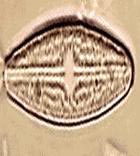
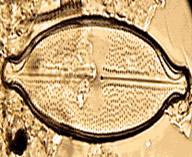
Pictures of some commonly found diatoms
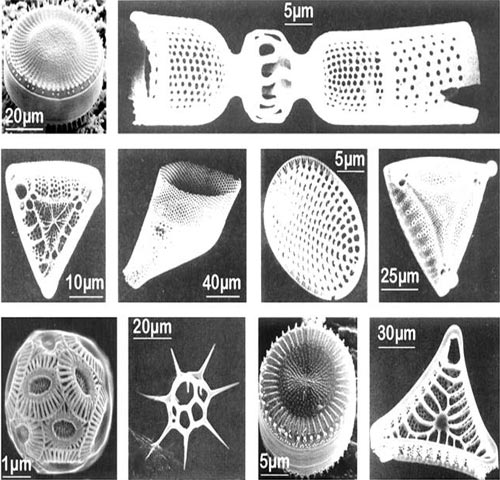
Different types of Diatoms (examples)
A) Freshwater diatoms
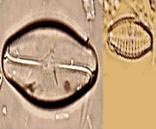
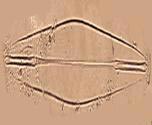
Achnanthes sp. Amphipleura sp.
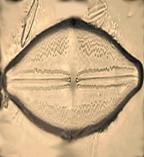
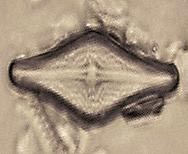
Anomoeneis sp.
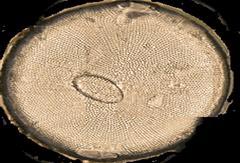
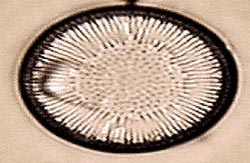
Biddulphia sp. Cyclotella sp.
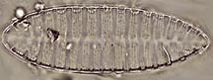
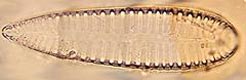
Surirella sp.
B) Marine water Diatoms
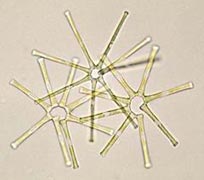
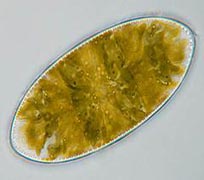
Asterionella sp. Cymatopleura sp.
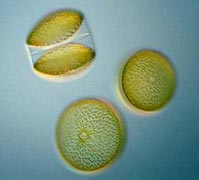
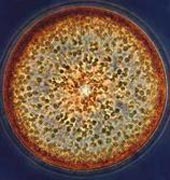
Coscinodiscus sp.
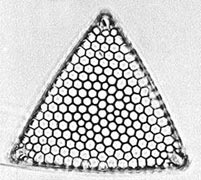
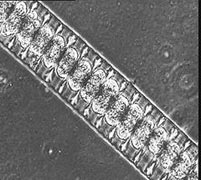
Triceratium sp. Bellerochea sp.
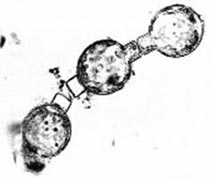
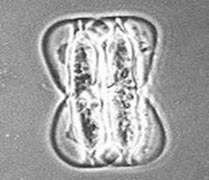
Melosira sp. (Auxospores) Amphiprova sp.
conclusion
Knowledge about types of drowning associated diatoms is always necessary for any forensic expert in diagnosing the drowning cases. Further studies like morphology and existence of diatom in different various water bodies of a specific zone can also be of great help in solving many suspected drowning cases. Presence of diatoms in ante-mortem drowning depends upon type, size and density of diatoms in a putative drowning medium. No doubt small diatoms (Diatoma, Cyclotella, Epithemia etc.) have more chances to enter into body organs but fairly large diatoms (Synedra) can also be found in body organs as they are delicate enough to get fragmented. Navicula, Nitzschia, Synedra ulna, Achnanthidium and Cyclotella are common types of diatoms found in body organs of drowned persons because they are widely distributed and with optimum sizes. Literature has been surveyed and following conclusion has been drawn:-
Body organ commonly found diatom species
| 1. | Lung | Achnanthes minutissima, Cyclotella cyclopuncta, Fragilaria brevistriata, Navicula etc. |
| 2. | Bone marrow | Stephanodicus parvus, Navicula, Diatoma and fragments of Synedra ulna. |
| 3. | Liver | Achnanthes minutissima, Cocconeis placentula, Fragilaria ulna var. acus, Navicula lanceolata etc. |
| 4. | Kidney | Achnanthes biasolettiana, N. seminulum etc. |
| 5. | Stomach | Achnanthes minutissima, Cyclotella cyclopuncta, Gomphonema minutum etc. |
| 6. | Duodenum | Asterionella |
REFERENCES
1. Auer A. Qualitative Diatom Analysis as a Tool to Diagnose Drowning. Am J Forensic Med Pathol 1991; 12 (3): 213-18
2. Funayama M, Aoki Y and Sagisaka K. Detection of Diatoms in Human Tissue and Blood by Using Membrane Filter. Act Crim
3. Funayama, M, Aoki, Y Sebetan, MI, Sagisaka K. Detection of Diatoms in blood by a combination of membrane filtering and chemical digestion. Forensic Sci Intern 1987;34: 175-82
4. Hurlimann J, Feer P, Elber F, Niederberger K, Dirnhofer R, Wyler, D. Diatom detection in the diagnosis of death by drowning. Intern J Legal Med 2000; 114; 6-14
5. Kasparck B. Dtsch.Zschr.Gerichtl.Med 1937; 27: 132.
6. Ludes B, Coste M, Tracqui, A, Mangin P. Contivuous River Monitoring of Diatoms in The Diagnosis of Drowning. J Forensic Sci 1996; 41(3); 425-28
7. Lunetta P, Penttila A, Hallfors G. Scanning and transmission election microscopical evidence of the capacity of diatoms to penetrate the alveoli-capillary barrier in drowning. Inter J Legal Med 1998 111; 229-37
8. Mueller B, Gorgs, D. Studien uber das Elindringen von corpiscularen Wasserbetandtielen aus den Lungenaveolen, in des Kreislauf wahrend des Ertinkungsvorganges. Ditch. Z. Gesamte Gericbtl. Med 1949; 39: 25-71.
9. Nanikawa R, Kotoku S. Medicolegal observations on a dead body drawn up from the sea bed, with special reference to ethanol and diatoms. Case Report. J Forensic Sci 1974; 3: 225-32
10. Pachar JV, Cameron JM. Scanning Electron Microscopy: Application in the Identification of Diatoms in Cases of Drowning. J Forensic Sci 1992 ; 37 (3): 860-66
11. Peabody, A.J. Diatoms in Forensic Science. J Forensic Sci 1977; 17: 81-88
12. Revenstorf, V. Der Nachwies der aspirierten Ertrankungs flussigkeit als Kriterium des Todes. Geritchtl Med 1904; 28: 274-79.
13. Round, E.F., Crawford, R.M. and Mann, D.G. The Diatom Biology and Morphology of Genera. Cambridge University Press, Cambridge,
14. Timperman, J. The detection of diatoms in the marrow of sternum as evidence of Death by Drowning. J Forensic Med 1962; 9: 134-36
15. Tyagi, G.D. Diatoms of Delhi. J.F.M.T.1985; 2 (3): 18-2
Back to Index