Back to Index
IIJFMT 3(3) 2005
SONE LAL MD, Sr. Demonstrator,
S. K. VERMA MD, MAMS, FICFMT, FIAFM, Professor
Department of Forensic Medicine
University of College of Medical Science, Dilshad Garden, Delhi – 110095
E-mail: vermasatish2003@gmail.com
ABSTRACT
Positional asphyxia is a condition arising due to adoption of particular body position that mechanically interferes with pulmonary ventilation. The phenomenon hardly found any mention in Indian forensic medicine literature. The authors describes here a case pertaining to 3 years old child, who died due to positional asphyxia in his own house after being entrapped in the space between the bed and wall of the room. The case also highlights the preventive forensic medicine aspect of such incidents.
Key Words:
Accident, positional asphyxia, child
INTRODUCTION
Positional asphyxia is a condition arising due to adoption of particular body position that mechanically interferer with pulmonary ventilation [1]. Ventilation depends on the movement of chest wall, rib cage, diaphragm, abdominal wall and other accessory muscles of respiration to generate intra-thorasic pressure that move gases through the airway to and from the lungs [2]. Ventilatory bellows failure leads to alveolar hypoventilation. The major causes of ventilatory pump failure are: a) decreased central respiratory drive; b) flail chest; and c) respiratory muscle fatigue and failure [3].
In case of death due to positional asphyxia the body is found in a position that interferes with normal breathing. In addition to the body position, other criteria suggesting the diagnoses of positional asphyxia have been proposed as: a) evidence that circumstances prevented the individual from escaping the fatal body position; b) historical information indicating that the individual had “difficulty” in breathing; and c) absence of other pathologic or toxicology finding clearly suggesting another cause of death [4].
Majority of reports pertaining to positional asphyxia are relatively recent and not more than two decade old [5-7]. Very few cases were reported earlier to 1980’s [8]. It is surprising that latest edition published after year 2000 of important forensic medicine books from
did not find even mention about positional asphyxia [9-11]. The authors describes about the case of a child, who died accidentally due to positional asphyxia. The case was unusual on two counts; a) age of victim; and b) circumstances surrounding the death. In the last some preventive measures are also suggested.
CASE DESCRIPTION
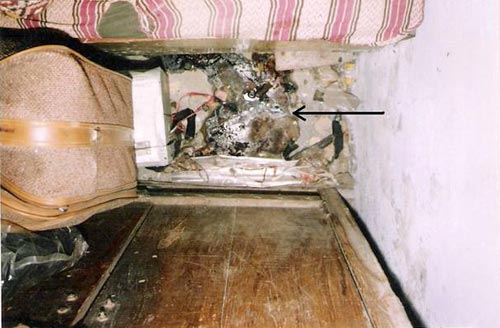
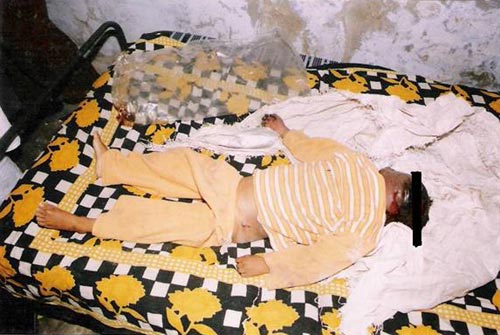
MA, a three and half year’s male child was reported missing from his house. Three days latter, a fowl smell emanated out from one of the rooms of the house. Thinking that smell is due to some decaying dead rat, the family members searched the house. During this process they found the decomposed body of MA with head down position in the space between the bed and wall (photograph 1,2). The clothing like quilt and blankets were covering the body entirely. The incident was reported to local police, who thinking it to be case of homicide and sexual assault, made an inquest and body was sent to this centre for medico legal postmortem.
AUTOPSY FINDINGS
The autopsy was conducted by one of the authors (SL) revealed the following findings:
a) External – Face was swollen with both eye bulging out from orbit and blackish in color, tongue caught in between the teeth, finger nails cyanosed. Marbling of skin over abdomen, upper and lower limbs. Cuticle separation present, loosening of scalp hairs, greenish discoloration of abdomen. Faecal matter present around anus. Small abrasions (reddish brown in color) present over rt. side face, rt. side forehead and lt. eye brow. No subcunjuctival hemorrhage observed in eyes (Photogragh-2).
b) Internal Examination – Brain was soft and congested. Both lungs congested with petechial hemorrhages on the surface. Epicardium also shows petechial hemorrhages. No hemorrhages seen in the neck tissues. Bony / cartilaginous structures of neck were intact. Partially digested food material was present in the stomach. Viscera analysis for poisons and alcohol was negative.
DISCUSSION
Asphyxia due to head down position is rarely encountered in medico-legal practice, and on autopsy may reveal no morphological finding which explain the cause of death sufficiently [6]. Head down position can occur due to various reasons, such as: sports accidents (alpinists, speleologists, parachutist etc.), surgical operations (during pelvis and lower abdomen surgeries) and during torture [8]. Positional asphyxia in head down position is a rare entity Even the long-term studies on pediatric mortality did not find any mention of positional asphyxia [12, 13].
In the present case a young child got asphyxiated due to: a) falling in the confined space between the bed and wall and unable to get out; and b) falling of heavy clothing like blankets & quilts kept in the vicinity. The death due to such an eventuality is usually reported from western and developed world [14, 15], may be due to better death reporting systems that exist in these countries. In
a) Better mandatory death reporting system;
b) Police should take appropriate action;
c) Safe sleeping environment especially for children (like avoiding small space between wall & bed); and
d) Education of children, their guardian/ parent and health care professionals.
REFERENCES
1. Belviso M, De Donno A, Vitale L, Introna F. Positional asphyxia – reflection on 2 cases. Am J Forensic Med Pathol 2003; 24: 292 – 97.
2. Ward M, Macklem PT. The act of breathing and how it fails. Chest 1990; 97: 36S.
3. Roussos C. Respiratory muscle fatigue and ventilatory failure. Chest 1990; 97: 89S.
4. Reay DT, Fligner CL, Stilwell AD, Arnold J. Positional asphyxia during law enforcement transport, Am J Forensic Med Pathol 1992; 13: 90.
5. O’Halloran RL, Frank JG. Asphyxial death during prone restraint revisited – a report of 21 cases. Am J Forensic Med Pathol 2000; 21(1): 39 – 52.
6. Madea B. Death in head down position. Forensic Sci International 1993; 61: 119 – 132.
7. Chan TC, Vilke GM, Neuman T. Re-examination of custody restraint position and positional asphyxia. Am J Forensic Med Pathol 1998; 19(3): 201 – 205.
8. Marshal TK. Inverted suspension. Med Sci Law 1968; 4: 49 – 50.
9. Dikshit PC (Ed). HWV Cox Medical Jurisprudence and Toxicology. The addition Lexis Nexis Butterworth’s, N. Delhi, 2002.
10. Dogra TD, Rudra A (Eds). Lyon’s Medical Jurisprudence & Toxicology. 11th edition, Delhi Law House, Delhi, 2005.
11. Mathiharan K, Patnaik A (Eds). Modi’s Medical Jurisprudence and Toxicology. 23rd edition, Lexis Nexis Butterworth’s, Delhi, 2005.
12. Meel BL Mortality of children in the
13. Bharduaj N, Rautzi R, Lalwani S. Death in children – a ten year retrospective study of legal autopsies in south Delhi. Ind Med Gaz 2004; 138:355 – 358.
14. Byard RW. Hazardous infant and early child loud sleeping environment and death scene examination. J Clin Forensic Med 1996; 3: 115 – 22.
15. Thogmartin JR, Sletert CF Jr, Pellon WA. Sleep position and bed-sharing in sudden infant death: an examination of autopsy. J Pediatr 2001; 136: 212 – 7.
16. Verma SK, Lal S. Strangulation deaths during 1993 – 2002 on east Delhi (
17. Lalwani S, Sharma GASK, Rautzi R, Bharduaj DN, Dogra TD. Pattern of violent asphyxial deaths in south Delhi – A retrospective study. Ind Med Gaz 2004; 138: 258 – 61.
Photographs 1. Child as recovered
Photograph 2. Showing the space between wall and bed.