IIJFMT 3(2) 2005
EFFECT OF STORAGE CONDITIONS OF SEMINAL STAINS ON DIFFERENT TEXTURES OF CLOTHS IN RELATION TO DNA YIELD
Raina A, Pramanik P, Dogra TD,
Department of Forensic Medicine, AIIMS, New Delhi-110029
The seminal stains recovered on fabrics are one of the most important evidence in rape cases. Stained clothing’s, undergarments and swab’s on fabric material taken from vagina and surrounding regions, are submitted for DNA Fingerprinting test to compare it with the blood sample of the accused person. Many a times, isolation of DNA from such stains particularly when the stains are old is not possible. The causes could be degradation or decomposition of the biological material, which depends mainly upon the environmental conditions. The other possible factors could be nature of clothing’s. In the present study, it was observed that maximum DNA recovery was from cotton clothing’s even when stored for long durations followed by tricot material.
INTRODUCTION
Sexual harassment, rape or in other words, “Crime against Women” are barbaric in nature. Earlier many of the rapists or suspects used to get free of punishment, as modern technologies were not available to identify them with certainty. But, the technique of DNA Fingerprinting, introduced by Prof. Jeffrey’s (1) has revolutionized the field of Forensic Science/Medicine as this tool helps to establish the identity of an individual even from body clothing’s, undergarments, surrounding areas etc. Such samples are collected and subjected for DNA analysis (2). Nonetheless, this technique has given justice to many innocents and at the same time convicted the accused. In
In many cases, the biological materials are recovered after examination of the victim or may be submitted after long time for DNA analysis or may be lying pending for DNA analysis. Therefore, the present work was taken up to study the effect of storage conditions and yield of DNA from different textures of cloth for seminal stains, the biological material forwarded in rape cases.
MATERIALS & METHODS
The semen samples were obtained from healthy volunteers (from AIIMS). About 2ml of these semen samples were spread uniformly on different textures of cloths and stored for different intervals. After storage, it was processed for DNA analysis using phenol extraction method (4). The isolated DNA was dissolved in EDTA and run on 0.8% agarose gel. The gel was stained with ethidium bromide and visualized under UV light using Gel Documentation system
RESULTS & DISCUSSION
In this study ethidium bromide was used as fluorescent agent. The result was interpreted by Alpha Erase Fc Tm software version 3.1.2 of Alpha Infotech.
The intensity of the fluorescent is directly proportional to the nucleic acid of DNA bound to the fluorescent material. Black background is measured as 0 and the brightest measurement is 255. A grayscale from 0 to 255 is used, where 0 is no molecules and 255 is completely saturated.
According to the given result, DNA yield has been gradually decreased with the increase of duration of storage. The yield has been estimated per 10 µl.
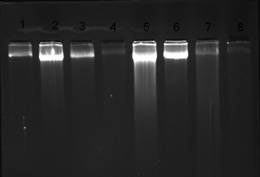
The yield of DNA isolated from seminal stain of eight individuals, stored at room temperature for 1 day varied from 10 ng-146.4 ng (fig 1). The average yield observed was 58.58 ng. The fewer yields could be due to technical fault (Table 1).
The samples processed for isolation of DNA after two days of storage at room temperature amounted surprisingly as low as 19.6 ng and the highest as 250.8 ng (silk material) of DNA (Table 5).
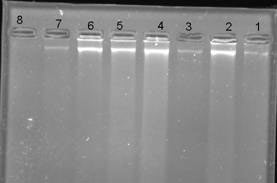
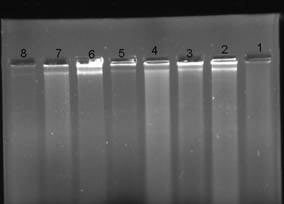
The yield of DNA after 14-days of storage from seminal stains of 8 different individuals ranges from 5 ng to 79.9 ng (fig.2). The average yields being 38.28 ng (Table 2). The same samples were stored further for 16 days and the yield of DNA was observed as 7ng to 22.22 ng (fig.3). The average yields are of 15.28 ng (Table 3).
The samples were stored further for 18 days and the amount of DNA varied from 15 ng to 45.6 ng (fig.4, photo not clear). The average yield was calculated as 12.69 ng (Table 4). Similarly, Ng DP et al (4) conducted a study. The amount of DNA extracted from 2 ml of saliva was stored under the different storage conditions. The purity of the DNA extraction, based on OD (260/280) ratios, was good and comparable. PCR resulted in the presence of a single specific product of the correct size from all samples regardless of saliva storage conditions but the yield varied. Finally it was concluded that Saliva could act as a useful source of genomic DNA, even when stored under less than optimal conditions.
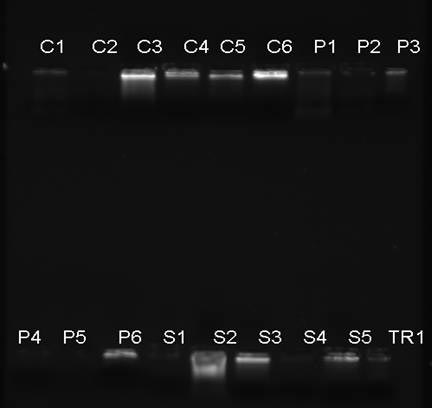
Further, seminal stains were stored for long duration, for one year and three months (March 2004-June 2005) at room temperature (varying according to Indian climatic situations). The seminal stains were preserved without any preservative and stored on different textures of cloths like polyester (P), silk (S), cotton (C) and tricot materials (TR). The DNA was extracted successfully only from one out of two cotton specimen and the yield was estimated as 35.6 ng. The other sample did not yield any DNA, could be due to decomposition or degradation. For polyester material, DNA yield varied from 5.7ng to 23.3 ng (Fig.5). From silk material DNA yield was observed as 7.9 ng and 33.8 ng yield was obtained from tricot material. Thus, suggesting that the cotton material is better source for such analysis (Table 5). Therefore, the use of cotton fabric for swabs for collection of seminal stains from vagina and other areas from body is the best among all fabrics studied.
The results obtained, clearly shows that in Indian climatic conditions (room temperature, 250C-370C), the DNA yield from seminal stains gradually decreases. It is also clear that time and temperature has certain deteriorating effect on DNA yield.
Bomjen et al (6) carried out a study, where the human blood samples were stored with and without anticoagulant (EDTA/heparin) for different duration and at different temperatures. Their study revealed that higher amount of genomic DNA was recovered from blood samples stored at temperatures 40C or below in the presence of EDTA or heparin.
Del Rio et al (7) carried out DNA analysis on the blood stained blue denim (light and dark blue, both) material. The organic and chelex methods were used for the isolation of DNA. Both the methods were tested for their ability to purify typable DNA. DNA purified from the light blue denim using either method was successfully used in obtaining correct HLA-DQ alpha typing results. The chelex, but not the organic, procedure was able to yield typable DNA when the dark blue denim was the substrate. Therefore, it was observed in their study that the chelex method might be more effective than the organic method in preventing compounds that inhibit PCR from co-purifying with the DNA.
Table 1. Fig.1
Lane No. |
ng |
AREA |
AVG |
Duration |
1 |
25 |
450 |
0.06 |
1 day |
2 |
125 |
714 |
0.18 |
1 day |
3 |
43.819 |
460 |
0.1 |
1 day |
4 |
0 |
405 |
0 |
1 day |
5 |
146.401 |
780 |
0.19 |
1 day |
6 |
118.091 |
624 |
0.19 |
1 day |
7 |
10.326 |
405 |
0.03 |
1 day |
8 |
0 |
396 |
0 |
1 day |
Table 2. Fig.2
 |
Lane No. |
ng |
AREA |
AVG |
Duration |
1 |
20 |
585 |
0.03 |
14days |
2 |
50 |
615 |
0.08 |
14days |
3 |
55.046 |
901 |
0.06 |
14days |
4 |
50.27 |
585 |
0.09 |
14days |
5 |
45.849 |
615 |
0.07 |
14days |
6 |
79.978 |
861 |
0.09 |
14days |
7 |
5.078 |
473 |
0.01 |
14days |
8 |
0 |
403 |
0 |
14days |
Table 3 Fig.3
 |
Lane No. |
ng |
AREA |
AVG |
Duration |
1 |
20 |
615 |
0.03 |
16days |
2 |
22 |
731 |
0.03 |
16days |
3 |
10.529 |
645 |
0.02 |
16days |
4 |
17.459 |
637 |
0.03 |
16days |
5 |
7.804 |
490 |
0.02 |
16days |
6 |
22.218 |
600 |
0.04 |
16days |
7 |
13.36 |
550 |
0.02 |
16days |
8 |
8.899 |
636 |
0.01 |
16days |
Table 4 Fig.4
 |
Lane No. |
ng |
AREA |
AVG |
Duration |
1 |
15 |
931 |
0.02 |
18days |
2 |
25 |
867 |
0.03 |
18days |
3 |
0 |
473 |
0 |
18days |
4 |
0 |
689 |
0 |
18days |
5 |
0 |
585 |
0 |
18days |
6 |
15.908 |
931 |
0.02 |
18days |
7 |
45.645 |
1215 |
0.04 |
18days |
8 |
12.646 |
893 |
0.91 |
18days |
Table 5
Lane No. |
ng |
AREA |
AVG |
Duration |
C1 |
35.6675 |
332 |
0.08 |
1.3 year |
C2 |
1.3 year |
|||
C3 |
155.959 |
418 |
0.37 |
2 days |
C4 |
58.263 |
324 |
0.18 |
2 days |
C5 |
89.971 |
322 |
0.28 |
2 days |
C6 |
188.844 |
407 |
0.46 |
2 days |
P1 |
23.343 |
360 |
0.06 |
1.3 year |
P2 |
5.744 |
220 |
0.03 |
1.3 year |
P3 |
38.331 |
290 |
0.13 |
1 day |
P4 |
4.631 |
352 |
0.01 |
1 day |
P5 |
1 day |
|||
P6 |
151.141 |
828 |
0.18 |
1 day |
S1 |
7.983 |
390 |
0.02 |
1.3 year |
S2 |
250.862 |
2261 |
0.22 |
2 days |
S3 |
200.822 |
836 |
0.27 |
2 days |
S4 |
19.679 |
555 |
0.02 |
2 days |
S5 |
159.107 |
1056 |
0.15 |
2 days |
TR1 |
33.801 |
810 |
0.05 |
1.3 year |
Fig.5
 |
REFERENCE
- Jeffreys AJ, Wilson V, Thein SL. Individual-specific 'fingerprints' of human DNA. Nature 316;1985:76-79
-
Raina A, Dogra TD (2003) Methods of collection, Preservation and Forwarding of Biological Material for DNA Fingerprinting. Ind Internet J Forensic Med Toxicol 1(2);2003; www.icfmt.org
- www.legalserviceindia.com/articles/rape_laws.htm
- Kido A, Masaaki H, Yasuhisa Y, Hiroshi K, Rie S, Kazuyuki S, Aya T, Masakazu O. Nine short tandem repeat loci analysis in aged semen stains using the Amp FLSTR Profiler Kit and description of a new vWA variant allele. Legal Medicine 5; 2003:93-96
- Ng DP, Koh D, Choo SG, Ng V and Fu. Effect of storage conditions on the extraction of PCR-quality genomic DNA from saliva. Clin Chim Acta 343; 2004 :191-194
- Bomjen G, Raina A, Sulaiman IM, Hasnain SE, Dogra TD. Effect of storage of blood samples on DNA yield, quality and fingerprinting: a forensic approach. Indian J Exp Biology 34(4);1996 : 384-386
- Del Rio SA, Marino MA, and Belgrader P. PCR-based human leukocyte antigen (HLA) DQ alpha typing of blood stained light and dark blue denim fabric. J Forensic Sci 41(3);1996:490-492