SKEWED SEX RATIO IN PUNJAB-A DEMOGRAPHIC CATASTROPHE
Singh D, Kumar A, Vij K,
Department of Forensic Medicine, Govt. Medical College, Sector 32, Chandigarh
ABSTRACT
Death is a tragedy in whatever form, at whatever time and in whatever way it lays its hands. Female foeticide is a unique form of violence against women. The word “abortion” has been derived from “abortus” which means “to take away” and truly, the practice takes away the wholeness of a woman who resorts to taking away the life of her own unborn child. Twin pressures of ‘Family Planning’ and ‘Dowry’ have brought female foeticide to such shameful proportion that sex ratio has been declining fast in India; more so in the state of Punjab and Union Territory of Chandigarh.
In wake of these developments, Five Head Priests of “Akal Takht”, the highest seat of Sikh religious authority in the Golden Temple at Amritsar issued a “Hukumnama” (an edict) in April, 2001, preaching excommunication of those involved in this heinous practice. The National Commission of minorities, too, has decided to take up the issue beginning with Sikhs and Punjabis. The paper highlights the magnitude of problem along with suggestive measures for combating the menace.
Key Words: Female foeticide, Male: Female ratio, Hukumnama.
INTRODUCTION:
“The missing of a girl child, the discrimination meted out to her and the denial of her basic rights is an issue of paramount concern and urgent action”
Death is a tragedy in whatever form, at whatever time and in whatever way it lays its hands. Femicide i.e killing of females, in modern times, has presented in its ugliest shape as female feticide(1). It is a unique form of violence against women. Sincetimes immemorial, the patrilineal, patriarchal and patrilocal indian society has been fanatically biased for male progeny with a corresponding discrimination against daughters (2). A son’s birth is likened to “a sunrise in the abode of God”, “a feather in one’s cap” etc. while a daughter’s birth has been equated to “watering a plant of other’s garden”(2,3). Indian mindset believes that they will only be able to achieve ‘Moksha’ through their sons. Manu Smriti states, “a man can gain both worlds through a son and gains eternity through a grandson” (4). The old practices like drinking lion’s blood, coitus in full moonlight, various ‘mantras’ mentioned in ‘Atharva veda’, ‘Punsavana Vidhi’ mentioned in Ayurveda, dietary modifications, scheduling time of conception, pre-conceptual use of acid/alkaline douches per vaginum, Chinese chart based on Chinese lunar calendar and many more methods, having no scientific basis were tried upon to beget sons (5).
FALLING SEX RATIO-CONTRIBUTION OF SCIENCE
The word ‘abortion’ has been derived from ‘abortus’ which means “to take away” and truly, the practice takes away the wholeness of a woman who resorts to taking away the life of her own unborn child. Although the scientific and technological progress has lessened human drudgery, the sex selective abortions based upon sex determination tests like amniocentesis, chorionic villous sampling, ultrasonography etc. substantiate the blatant use of technology for anti-women purposes (5). Apart from the adverse effects on the physical health of mother, the much longer lasting psycho-emotional impact in the form of guilt sense, nervous breakdown etc. need not be over-emphasized (3). Medical advancements have created, by default, a win-win situation for all the perpetrators of female feticide. The trauma of repeated conceiving and aborting has been eliminated to a great extent by Newer Reproductive Technologies like pre-conception techniques, pre-implantation genetic diagnosis and DNA probes (3,5). With the mobile ultrasound machines moving freely around the countryside, it would just be a matter of time before rural India catches up with its urban counter part in the race “to do away with the unborn girl child” (6) .
MAGNITUDE OF PROBLEM IN COUNTRY
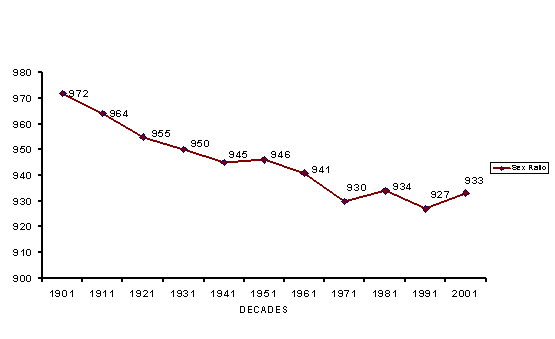
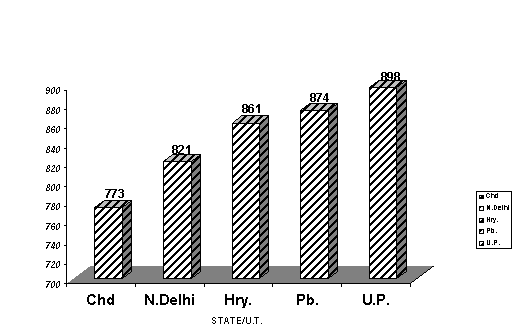
Twin pressures of “Family Planning” and “Dowry” have brought the magnitude of female feticide to such shameful proportion that sex ratio has been declining drastically in India (Graph I). Census statistics are the surface indicators of deep rooted gender bias. The Juvenile sex ratio (0-6 year age group) has steadily declined from 945 in 1991 to 927 in 2001. The sex ratio of U.T. of Chandigarh (773), New Delhi (821), Haryana(861), Punjab(874) and Uttar Pradesh(898) have been included in “below 900” Category (Graph II). It is a national shame that the national capital territory of New Delhi has one of the lowest sex ratios amongst the Indian states (7).
SCENARIO IN PUNJAB
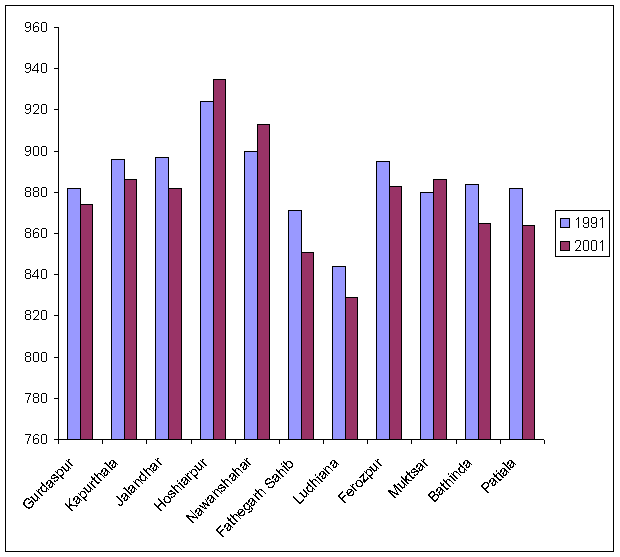
The inhabitants of Punjab, who pioneered the green revolution in the last century, are now heading for a devastating economic and social fall out in the near future due to sharply declining (882 in 1991; 874 in 2001) sex ratio(8). The reasons of ‘son-mania’ are socio-cultural, economic and political ones (3). Among others, the predominant cause is the agrarian set-up associated with the ownership of land and the social infrastructure sustained by Punjabi’s that accords a low status to women (9). Chandigarh, the City beautiful has the dubious distinction of having the lowest sex ratio (773) in whole of the country despite its high literacy rate of 81.76%(7). The worst affected districts of Punjab are Ludhiana (824), Fatehgarh Sahib (851) and Patiala (864)(Graph III). With 11.4% increase in literacy rate during the last decade (58.5% in 1991; 69.95% in 2001), The juvenile sex ratio of 793 compared to overall sex ratio of 874 is a cause of concern in one of the most prosperous states of India (7). Among the Sikhs in Punjab, a further fall in juvenile sex ratio (only 780), clearly indicates that social practices among Sikh masses have grossly diverged from the egalitarian principles, emphasizing gender equality, set forth by the “Sikh Guru’s” as recorded in the scriptures of “Guru Granth Sahib”, the holy book of Sikhs(10).
The boards displayed in nursing homes that “Sex determination tests are not conducted here” is just a ploy to hoodwink the authorities. The reports of recovery of female fetuses from drains, garbage dumps, public lavatories etc. have created shock and public outrage in the state(6). Legal instruments like MTP Act, 1971 and PNDT Act, 1994 and their subsequent amendments could not check this menace. Governmental efforts through ad-campaigns, documentaries, workshops etc. have proved inadequate in this regard. The voluntary and non-governmental organizations too are still groping in the dark.
In wake of these developments, “Akal Takht”, the highest seat of political and spiritual power of Sikhs has raised an alarm. A “Hukumnama” or edict has been issued on 18th April 2001, that any Sikh indulging in female feticide could be excommunicated as the practice was forbidden under “Rehat Maryada” (The Sikh code of religious conduct) issued by Shiromani Gurudwara Prabandhak Committee(SGPC)(10).
POSSIBLE HAZARDS
It has been seen that populations with more number of males remain at risk of social unrest with increase in crime and violence against women like dowry death, child marriage, bride selling, kidnapping, rape etc. The risk of polyandry also exists in such a society(2,3,11). Stringent measures need to be taken to end this discriminating offence. Education system should promote gender equality right from school. Family with strong male bias should be psychologically counseled. So far as sex selection as an offence is concerned, it should be made cognizable(12) and tried under the same section as “Attempt to murder”(Section 307 IPC). Also, setting up self-help groups among women, targeting educated women, rewarding all girl families, setting up help-lines adopting new social customs, banning dowry stringently, registering and taking care of expectant mothers including postpartum follow-up, rewarding voluntary sterilization in girl dominating families etc. are some other measures (13). At weddings, Pandit’s/Granthi’s/Kazi’s etc. should forbid the couple against discrimination to girl child. TV channels like “Sanskar” and “Aastha” can play a positive role in this direction (11). The edict issued by SGPC in 2001 is a very positive step in curtailing female feticide. The National Commission of Minorities, too, has decided to take up the issue beginning with “Sikh’s & Punjabi’s”(8). The ‘Jathedars’ should also be incorporated in this noble mission. The Central Social Welfare Board has started implementation of “Manvi Sanrakshan Abhiyan” all over the country by 32 state boards(3). Recently, the Sikh religious leaders and top government officials participated in a “Oath taking” ceremony as a gesture for the commitment to the cause of unborn girl child.
POSSIBLE INTERVENTIONS
Instead of decennial surveys, annual appraisal of sex ratio in worst affected states and districts should be done. Daughters should get the right to perform the last rites of their parents equivalent to that of sons. The government should amend the existing laws of inheritance. The daughter should be accepted as heir to ancestral property legally as well as socially. Exemplary punishment should be given to the doctors who aid/indulge in this heinous practice of conducting sex determination tests (14). Such doctors should be punished by MCI under the offence of “Professional Misconduct”.
We should not wait for social transformation to take care of this burning issue.
We may be paving way for more hazardous technologies that may have more catastrophic results. There is urgent need to change the mindset of people (15). The millennium development goals of gender equality and the empowerment of common should be on top priority (16). Last, but not the least, everyone should imbibe the divine revelation received by Guru Nanak and preached to all his followers:“From woman man is born; within woman man is conceived; to woman he is engaged and married; women becomes his friend; when his women dies, he seeks another woman; to woman he is bound. So why call her bad ? From her kings are born”(10).
India’s missing women cannot be brought back to life but the future generations of women can be protected if we take the campaign against female feticide on a war footing.
Acknowledgement:
Authors are highly thankful to Dr. Naveen K. Goel, Reader, Community Medicine, GMCH, Sector 32, Chandigarh for providing latest census data. Ms. Rupinder Kaur and Ms. Kulwant Kaur are also being acknowledged for their secretarial assistance.
References:
1. Krishna Kumari DB, Vani C. Media for Gender Empowerment. Social Welfare. Oct.2004; 37-40.
2. Mallick A. India's Missing Women. Social Welfare. July 2004; 4-10.
3. Anand M. Female Foeticide - A quest for survival. Social Welfare. Sept. 2004; 5-8.
4. Pannu GK. Prevention of femicide and relevant legislations. Social Welfare. July 2004; 11-15.
5. Ravindra R.P. Refined techniques of Femicide, foetal sex determination and sex pre-selection/technical aspects. Available from http://www.hsph.harvard. edu/Organizations/healthnet/SAsia/suchana/9999/femcide.html
6. Rao R. Missing Girls of Punjab. Social Welfare. March 2004;37-38.
7. Census of India. 2001.
8. Khosa A. Minority panel wants jathedars to fight foeticide [Internet]. The Indian Express 29 Sept.2004. Available from http://www.indianexpress.com/ full_story.php?content_id=56096
9. Newkerala.com. Punjab agrarian setting behind Sikhs 'dismal sex ratio'. 2004. Available from http://athens-olympics-2004.newkerala.com/index.php?action= fullnews&id=30651.
10. Take issue [Internet] Available from www.sikhe. com
11. Forum. How to stop female foeticide. The Tribune 2004 November 01.
12. Forum. How to stop female foeticide. The Tribune 2004 October 18.
13. Forum. How to stop female foeticide. The Tribune 2004 October 25.
14. Forum. How to stop female foeticide. The Tribune 2004 October 11.
15. Female foeticide widely practiced in Punjab. Chandigarh, UNI, 2004 available from :http://www.deccanherald.com/deccanherald/apr102004/n2.asp
16. Gupta KN. A child is a blessing - Be a girl or a boy. Social Welfare. Sept.2004; 9-12.