IIJFMT 2(3) 2004
ESTIMATION OF AGE FROM COUNTING OF CONCENTRIC LAMELLAE PER OSTEON IN HUMAN COMPACT BONE
Lal, S*, Sharma, G.K.**, Murari, A. ***, RATH, G . ****
* Senior Demonstrator, Deptt. Of Forensic Medicine, UCMS and GTB Hospital, Delhi.
** Principal and M.S. Lady Hardinge Medical College and S.K. Hospital, New Delhi.
*** Director Professor and HOD Deptt. Of Forensic Medicine Lady Hardinge Medical College and S.K. Hospital, New Delhi.
**** Professor and HOD, Deptt. Of Anatomy V.M College and Safdarjung Hospital, New Delhi.
ABSTRACT
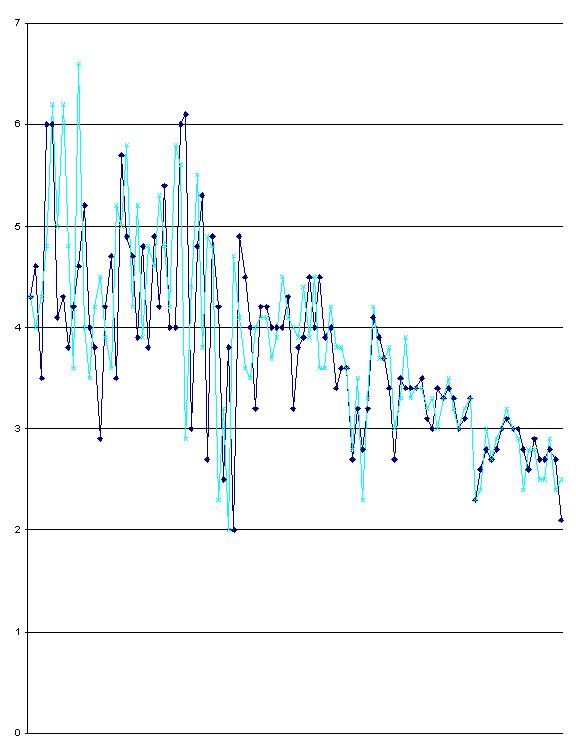
A histological study was conducted on 100 subjects of both sexes (M-50, F-50) from the compact portion of the tibia to observe changes related to age in the lamellae per osteon, in the haversion system in human compact bone. In majority of cases it was observed that the number of lamellae was found to be 6 to 10 per osteon from 18 to 55 yrs. of age. After 55 yrs. of age, 3 to 4 lamellae were seen, per osteon.
KEY WORD: - Compact bone, Lamellae per Osteon, Age Determination.
INTRODUCTION
Determination of identity from human skeletal remains has been one of the most challenging tasks for the forensic medico legist. Age is an extremely vital parameter in personal identity of living subjects as well as skeletonised dead bodies. Determination of age from skeletal remains has been studied and analyzed by many workers.
Many researchers have studied the determination of age at the time of death from histology of compact bone. It is not only possible to differentiate between non-human and human bone fragments Schranz1(1954), but also the age of are individual bone, elaborate studies were conducted by different workers like Beart2 (1964), Kerley3 (1965), Chatterji and Jaffery4 (1968), Kerley5 (1969), Ahlquist et al6 (1969), Kerley and Upelaker7 (1978) and Iwamoto, Oonuki and Kanschi8 (1978).
The most effective study out of several other studies on bone histology and age related changes was carried out by Kerley3, 5 (1965 & 1969), who developed a method of age determination based on microscopic analysis of the cortex of the long bones. Singh and Gunberg9 (1970) studied bone section for average number of lamellae per osteon and other parameters. They concluded that compared to existing morphological methods, microstructure of bone cortex can be quantified to estimate age at death more accurately. The present study was done for determination of age of the individual at death of both sexes from the compact portion of tibia on histological observation by statistically derived revised regression equation.
MATERIAL AND METHOD
This study was done on compact portion of tibia of both sides, approximately at the middle of shaft, collected from 50 males and 50 females of known age, brought for post mortem examination at Lady Hardinge Medical College, New Delhi. Bone sample from adult persons devoid of any bony anomalies, between the ages of 18 to 65 years were studied.
In the present study slides from bone samples were prepared by undecalcified method. Initially the bone samples were boiled in soap solution for fours hours to remove organic material. After washing they were suspended over Chloroform for 48 hours to remove fats. Each section was hand grinned until they become transparent. Transparent section was fixed on the slides with the help of D.P.X. mountant.
Average numbers of lamellae per osteon were counted in all osteons present in two fields. Incomplete on obliquely cut osteons were excluded. The data was statically analyzed and revised regression equation was derived.
OBSERVATIONS
The present study comprised of 200 samples of compact bone collected from middle portion of tibia of both the sides from 50 males and 50 females. The cases were between the ages of 18 to 65 years.
The lamellae per osteon were counted in all osteons present in the two fields. Examining bone sections in light microscope reveal a large amount of mineralized extra cellular matrix arranged in plates turned lamellae. Lamellae contain small lacunae and an anastamosing network of minute canaliculi. Depending upon their arrangement, lamellae were classified into three parts: -
(a) Concentric lamellae,
(b) Circumferential lamellae,
(c) Interstitial lamellae.
(a) Concentric lamellae: - These were present around a canal known as haversian canal up to 55 years. The concentric lamellae were very clear and were at varying distance from each other. There were 6 to 10 lamellae per osteon. After 55 years of age decrease of concentric lamellae was noticed and around 3-4 lamellae were discernible per osteon.
(b) Circumferential lamellae: - These lamellae were arranged as parallels bundles deep to the periosteum. They were present parallel to the surface also. There number varied from 6 to10.
(c) Interstitial lamellae: - These lamellae were present between adjoining osteons at younger age group. These lamellae were very clear but after 55 years of age, the number was found to be reduced at some places.
Following regression equation was derived after statistical evaluation of the data of concentric lamellae –
Age = Average number of lamellae per osteon - 88.100
-0.830
However there were no significant differences in number of lamellae per osteon of right and left side and between the two sexes.
DISCUSSION
Age estimation from skeletal material is hardly a new idea, but its usage and popularity bear’s an inverse relationship to its validity and reliability. This investigation was important because very often only bone fragment are available for individual identification and estimation of age depends upon gross morphological criteria, which are useful, but are limited in application.
Quantitative histology on the other hand permits objectivity and the resulting data are amenable to statistical evaluation. Gross morphological examination is a fairly reliable method for estimating the age below 25 years Krogman10 (1986). The present study was to estimate the age at death of even older individuals and more importantly from a small fragment of the available bone.
According to Singh11 (1992), the number of lamellae in each osteon was highly variable. Where as William et. al12 had noticed 6 to 15 concentric lamellae per osteon. In our study the number of lamellae per osteon is not found to be constant in young and in middle age group where as the number of lamellae decrease after about 55 years of age. This may be due to decreased number of osteocytic which fails to deposit matrix or this may be due to very close apposition of lamellae presenting false appearance of decreased lamellae is secondary osteons.
REFERENCES
- Schranz D. Age determination from the internal structure of the humorous. Am J Phys Anthrop, 1954:17; 273-277.
- Beart H. Assessment of age by the measurement of Haversion canal of human bone. J Forensic Sci 1964:5; 195-199.
- Kerley ER. The microscopic of age in human bone. Am J Phys Anthrop 1965: 23; 149-163.
- Chatterji S, Jaffrey JW. Changes in structure of human bone with age. Nature 1968:290; 482
- Kerley ER. Age determination of bone fragments. J Forensic Sci. 1969:14;59-67.
- Ahlquist J, Damsten O. A modification of Kerley’s method for the microscopic determination of age in human bones. Forensic Sci. 1969:14; 205-217.
- Kerley ER, Ubelaker DH. Revision in the microscopic method of estimating age at the death in human cortical bone. Am J Phys Anthrop1978: 49; 545-546.
- Iwamoto S, Oonuki E, Kanschi MA. Study on the age related changes of the compact bone age estimation on the femur bone”. Med J Kinki Univ (
- Singh IJ, Gunberg DL. Estimation of age at death in human males from quantitative histology of bone fragments. Am J Phys Anthrop1970: 33; 373-382.
- Krogman WM. The Human Skeletal in Forensic Medicine. 2nd ed CC Thomas, Springfield 1986:180-184
- William PL, Warnick R (eds.). Grey’s Anatomy, 38th edition, ELBS with Churchill living stone, Edinburgh1995: 452-468.