IIJFMT 1(2) 2003
DETERMINATION OF AGE FROM TEETH USING INDEX VALUE OF ATTRITION
Dr. Sumit Seth, Jr. Resident
Dr. Upender Kishore, Sr. Resident
Dr. Atul Murari, Professor
Dr. G.K. Sharma, Director Professor And Head.
Department of Forensic Medicine and Toxicology, Lady Hardinge Medical College and Assoc. Hospitals, New Delhi – 110 001
ABSTRACT
Study was conducted in LHMC & Associated Smt Sucheta Kriplani Hospital New Delhi to estimate age from central maxillary incisor by calculating the index value of attrition. Total number of cases studied was one hundred and fifty. The objectives of the study were to evaluate the degree of attrition as objectively as possible, neutralizing the role of oral pathology and its correlation with age.
KEY WORDS: Age estimation, incisor, attrition, index values.
INTRODUCTION
Age determination plays a crucial role in Forensic Medicine, not only in identification of bodies but also in connection with crimes & accidents. At times teeth are the only means of identification when the dead bodies have under gone changes so extensive, that external characteristic yield little information. Recent earthquake in Gujarat (26th Jan, 2001) & World Trade Center attack (11th Sept, 2001) has brought into focus the importance of teeth in the determination of age of individual and thus helping in their identification. Gustafson (1950) used a point system running from 0 to 3, to assess the regressive changes in teeth. Attrition was one of the important criterion used in his study. This point system was no doubt very innovative, yet it suffered from arbitrariness. It also did not neutralize the role of oral pathology. Smith (1950) and Maples et al (1979) in their work on Gustafson’s method also encountered some difficulties in age estimation.Kashyap & Rao (1990) modified the Gustafson’s method. The regressive change in attrition of the crown was observed using 25 cases with known age, sex & habitats. The index value of attrition was calculated by measuring the width of attrited area in relation to the width of the teeth, so that the degree of attrition was assessed with objectivity. The results obtained were reproducible.The present study was conducted on central maxillary incisor teeth for the degree of attrition using index value and its correlation with age. It was an attempt to increase the accuracy of age determination by using regression equation.
MATERIALS & METHODOLOGY
This study was conducted in the department of Forensic Medicine & Toxicology at L.H.M.C & Smt. Sucheta Kriplani Hospital New Delhi in year 2001 – 2002. Central maxillary incisor teeth were extracted from the dead bodies brought for post-mortem examination and grinded symmetrically from both sides to prepare 1 mm longitudinal section. Only those subjects who were between the ages of 25 to 75 years were selected. The index values of Attrition was calculated using the following formula.
Index
value of attrition = a x 100
A
Where ‘a’ is width in mm of attrited teeth &’A’ is the width in mm of the teeth at the cervical margin. The index values of attrition for all the 150 cases were plotted against the known ages and statistically analysed to derive regression equation.
OBSERVATIONS
A total number of 150 central maxillary incisors were studied in year 2001 – 2002, between ages of 25 to 75 years. Depending upon the age cases were dividing into five groups.
TABLE NO. - 1: AGE DISTRIBUTION
| S.NO. |
GROUP |
AGE INTERVAL |
NO. OF CASES |
PERCENTAGE |
| 1 |
A |
25-35 YRS. |
78 |
52 |
| 2 |
B |
36-45YRS. |
32 |
21.3 |
| 3 |
C |
46-55 YRS. |
20 |
13.3 |
| 4 |
D |
56-65YRS. |
17 |
11.3 |
| 5 |
E |
65-75YRS. |
03 |
2.1 |
| TOTAL |
150 |
100 |
Fig. 1 : Age Distribution
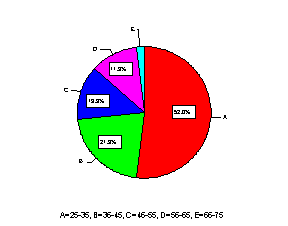
In-group A (25 – 35 years) the index value of attrition ranged from 35.5 to 60.0. In-group B (35-45 yrs) the index value ranged from 34 to 86. In-group C & D the values ranged from 63 to 92 & 87 to 94.5 respectively. The following regression equation was obtained from the scatter gram (Fig. 2).
Age = 0.606 x Index value of attrition – 0.474
Fig. 2: Relationship between Age and Index Value of Attrition
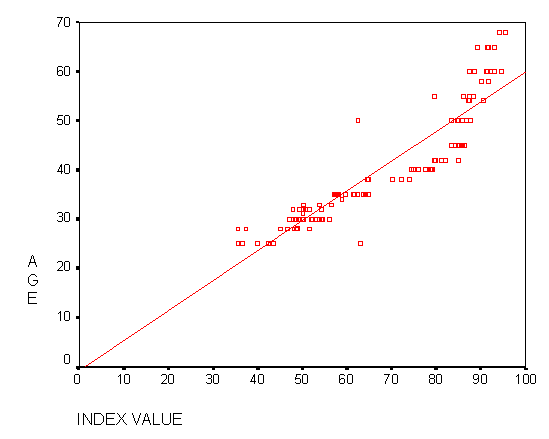
The equation proved to be highly significant as R. constant was 0.925 where as R square value was 0.855.
DISCUSSION
The study conducted by Gustafson (1950) showed that with age the degree of attrition of teeth also increased. In the present study a linear relationship between the attrition & age was also obtained.
Kashyap and Rao (1990) found that their method was more accurate in estimating age between age group 18 – 45 years. In our study it was found that the index values of attrition were most effective in estimation of the age between 25 – 50 years, which is consistent with the findings of Kashyap & Rao.
Kashyap and Rao (1990) estimated age by using a multiplication factor of 1.66 for attrition. However the regression formula derived in our study is considered to be more accurate.
CONCLUSION
In the present study 150 central maxillary incisors were taken .The index values of attrition based on actual physical measurement was calculated. The regressive changes were estimated more precisely and objectively. The results were reproducible. The influence of oral pathology was minimized due to similar influence on attrition & its constant.. The level of accuracy in estimating age using index value of attrition of maxillary teeth was found to be very high between the ages of 25 to 50 years. However the estimated age from regression equation was on the lower side in subjects above the age of 50 years.
BIBLIOGRAPHY
1. Boyde (1963). Quoted in : Cameron J M, Sims B G. Forensic dentistry Ist
ed. Edinberg, Churchill Livingstone. 1974; 38-39.
2. Gustafsun
G. Age determination on teeth. J Am Dent Assoc 1950; 41: 45-54.
3. Kashyap
V K, Rao N R K. A modified Gustafson method of age estimation from teeth.
For Sci Int ----47 : 237 – 247.
4. Maples
W R and Rice P M. Some difficulties in the Gustafson dental age estimations.
J Forensic Sci 1979; 24: 168-172.
5. Smith
quoted in : Gustafson G. Age determination on teeth. J Am Dent Assoc 1950;
41: 45